

Being busy sounds stressful and is the tell-tale sign of burnout. But it isn’t that per se. Always doing something doesn’t mean a full cognitive or physical load that completely consumes you. Instead, it can be small tasks that culminate into something you are proud of. It is so common now to be doing nothing. And I don’t mean a humble way of saying you went to the shops and bought new shoes, or washed the dishes, lowering these actions to insignificant common items in the day.
I mean;
Staring at a screen. Scrolling to kingdom come. The world could end now, and you’ll say: “Hold on, he’s about to do something funny.”
It really gets at me, and I do this myself, scrolling through Instagram, TikTok, YouTube or whatever platform, and I achieve not a single thing. All I get is temporary, instant gratification and a couple of laughs.
What are the costs of wasting time on such a mind-numbing ritual?
Yes, you may say, I am so drained I need a break. But does that break have to be 2 hours long after each 30-minute work interval when you have an assessment?
After you pull yourself away from the World Wide Web, you look at the time and realise all that time is gone. Poof. MIA. You cannot get that time back, no matter how hard you try. This then results in more stress, more escapism, and procrastination, mental fog, and more stress. Such a vicious cycle of doing nothing and stressing over it is not healthy. The World Wide Web ended up spinning you up into a silk mummy, entangling you in its holes and strings of attractive, sticky gratification. Then the spider of reality comes looming, its shadow of gloom signals your doom. You have spent too much time on the web that you are now trapped in it. Trapped in a vicious cycle of stress and escapism right before the deadline of an assessment.
Is this cycle worth it in the long run?
According to the Atlantic, more than 70 per cent of university students procrastinate on their schoolwork, and more than 20 per cent of adults in a 2005 survey were found to be “chronic procrastinators.” That is astronomical.
With procrastination becoming a prevalent norm within daily life, it seems impossible to defeat such a monster of avoidance. There is quite a lot of science explaining why humans avoid difficult tasks, seek gratification, and offer ways to move away from mindless scrolling.
Arthur C. Brooks explains that procrastination can be good in some ways, but it must be productive. When “deployed strategically with certain creative tasks, a little procrastination can actually be beneficial.” Instead of diverting immediately to social media to procrastinate a big assessment, you might want to wash the dishes or annotate a poem for English. By productively procrastinating, you are still getting things done, but you avoid the stress of writer’s block for your essay.
In constantly doing something, we reach a flow state of productivity. Completing an artwork, writing an essay, creating a video, or doing something fun with focus and full enjoyment. We end up doing more in the long run and enjoy doing it. Starting off with a small task and finishing it gives you a little buzz. On the other hand, starting off with an hour of reels leaves you unmotivated and entangles you in the world wide web of soulless gratification.
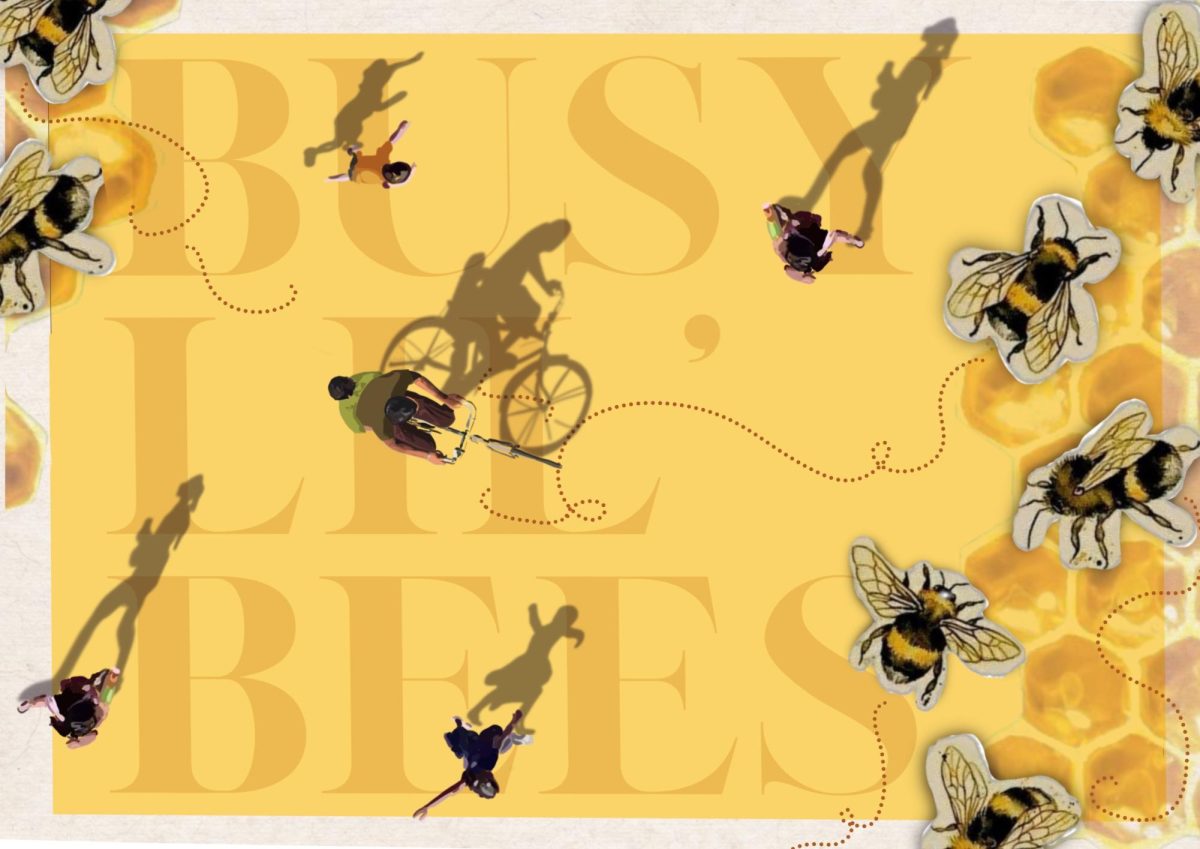
A perfect example of the benefits of constantly working is the honeybees.
Bees are always busy. Busy pollenating, making honey, drinking nectar, napping, working for the hive, feeding the queen and protecting the hive. They benefit humanity from a holistic view. They make your garden look nice, but also allow it to grow into your own slice of Eden. They make the honey that goes into your morning coffee or on your breakfast crumpets. They make wax and honeycomb, and countless other things. All of these things are achieved in such a short life span of honeybees; female workers live up to 60 days while male workers live up to 32 days, but the hive works collectively to achieve great deeds. Humans have years! Decades and near centuries to live.
What could we do with all that time?
What could you do in just a month or two?
Imagine if humans adapted the honeybee mindset, how society would bloom like pollenated flowers. No zombies walking around glued to 3-second videos in an endless stream. No wasted time spent on senseless, motionless procrastination, but collaboratively working towards something of substance. This substance doesn’t mean finding the cure to cancer, which would be nice, but a small action, like baking cookies or doing a little bit of gardening. Sitting outside and enjoying the busy little bees flying around your labour of love, pollinating the daisies and lavender you planted a week ago. And instead of lying numb on your bed gazing enthralled at that seductive black screen, you decided to do.
Do item 3 on your long list of to-dos, do 5 questions of your math homework, and do a spot of gardening.
Do a 2 km walk. Do a paragraph of your essay before having a well- needed nap. Do that video for your social media page, then read a chapter of a book.
Just Do. And reap the fruits of your labour.

Vineyard Z • Apr 29, 2026 at 9:29 pm
This is such a wakeup call, I was really made so much more