
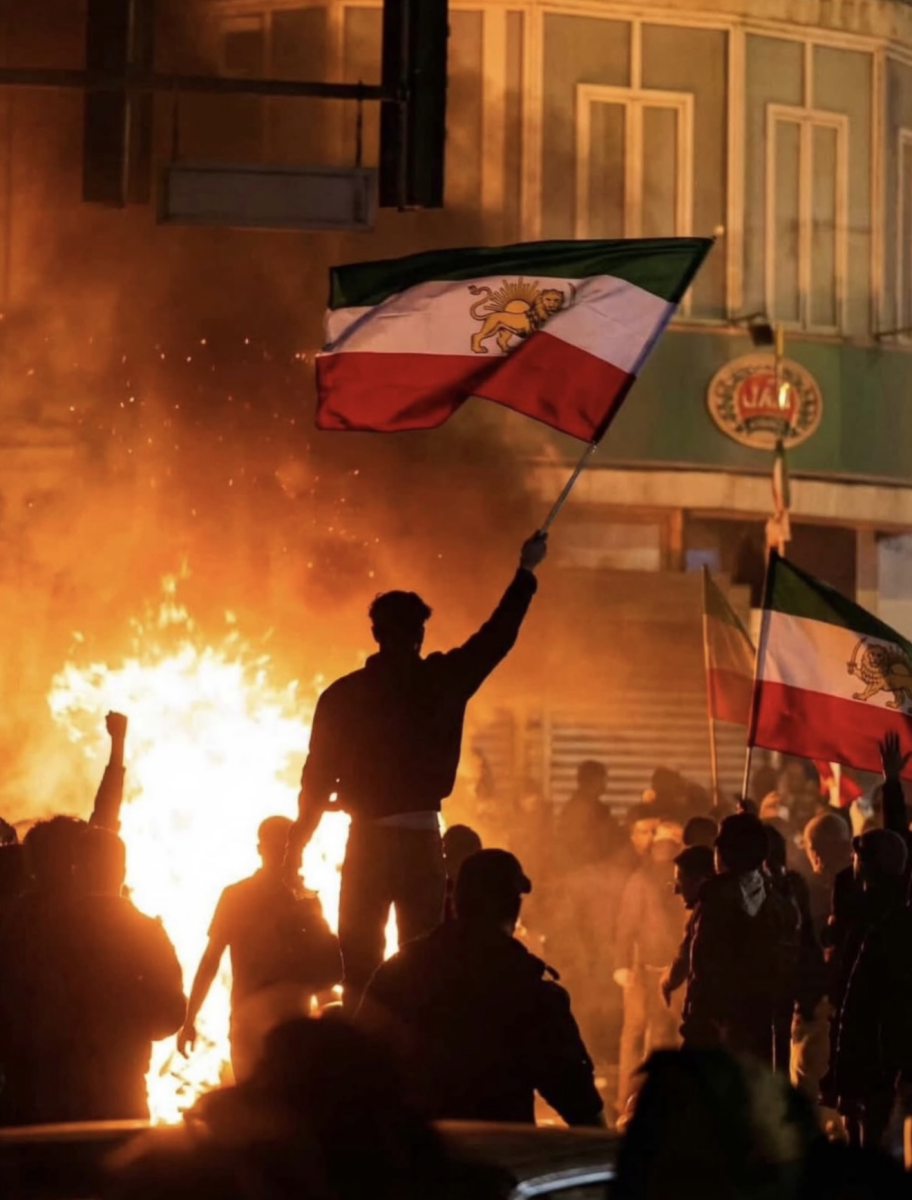
What is unfolding in Iran is not mere unrest; it is millions of people refusing to disappear quietly into oppression.
Since the revolution in 1979, Iranians have endured a government that controls nearly every aspect of life – a ruling system where real political power rests with an unelected Islamic theocracy and security forces, rather than with the people. Basic freedoms are supressed; differing religious beliefs are persecuted; peaceful protests are met with force; women’s bodies are regulated by the state and fear is used as policy. Things that we often take for granted – dancing, walking our dogs, holding hands, showing our hair – is prohibited under the regime. Surveys conducted within the country indicate that of Iran’s 92 million citizens, 70-80% say they would not vote for the current system and want regime change. Iran is clearly not its government. The people are not the regime. The culture is not the ideology. The nation is not the state that occupies it. Conflating the two erases the very people risking their lives to change it
For decades, Iran has lived under a cycle of repression and resistance. Over the past two months, nationwide protests have sparked. This is not an isolated eruption of unrest, but the continuation of a struggle that has been ongoing for decades.
Thousands of brave Iranians fill streets and squares, chanting slogans like “death to the dictator” and “this homeland will not be free until the mullah is gone”. The response has been merciless. Security forces, including the Islamic Revolutionary Guard Corps, have killed over 35,000 people, making this the deadliest massacre in Iran’s modern history. Tens of thousands more have been arrested. Bodies are withheld, graves unmarked, and mourning becomes an act of courage.
This is not a new pattern. In 2022, Mahsa Amini, a 22-year-old woman, died after being detained by Iran’s morality police for allegedly violating compulsory hijab laws. Her death sparked nationwide protests under the banner “Woman, Life, Freedom”, revealing the depth of systemic oppression and inspiring millions to demand change. Today’s uprisings continue her legacy. Only a week ago, more than 250,000 people protested in Munich, raising their voices for those that cannot back home.
For me, this crisis is deeply personal. My mother was only eighteen when she was forced to flee her home and become a refugee, after witnessing her father being tortured and persecuted for his faith when she was just a young girl. The loss of my grandfather lives in our family, shaping how we see freedom as fragile and never guaranteed, as my father now stands at protests in Town Hall and Hyde Park, raising his voice for those who cannot. Every statistic is a name, every death a story like my family’s, and every act of bravery a testament to the unyielding desire for freedom.
Yet the world watches in silence. Governments and international organisations issue neutral statements claiming to support the Iranian people but condemn nothing and take no meaningful action. Their words offer false hope, while repression continues unabated. Major media outlets frequently reduce these uprisings to economic unrest and move on quickly, thus obscuring the clear, political demand for freedom. Internet blackouts and suppression of journalists make the scale of suffering almost invisible.
The cries of the people are real; the world’s response is hollow.
The tragedy of the past two months is not only in the staggering death toll but in its haunting familiarity – decades of courage and grief repeating itself. I write not only as a student observing history, but as the child of survivors, carrying both grief and belief that one day, Iran will be free. That the world will stop looking away.
Mr Chahine • Feb 18, 2026 at 12:58 pm
An excellent piece, Statira. The selective outrage and hypocrisy of certain world leaders (and media voices) has been particularly disappointing, albeit unsurprising.
Lilly • Feb 18, 2026 at 12:15 pm
Great read!