
Last week, I typed a single sentence into an AI generator. Seconds later, it gave me a poem. It was structured. Polished. Almost beautiful. And yet — it felt empty. No trace of a person behind it.
In the name of technological advancement, society has forged a profound paradox:
A machine can now compose a symphony without ever knowing love, or heartbreak or grief.
A machine can now draft an entire manuscript without a smudge of ink ever appearing on its hands.
If we continue down this path, the future will not simply lack intelligence.
It will lack humanity.
Art has never been about speed. It has always been about depth. About daring to express what cannot be quantified. The greatest works in history were not produced because they were efficient. They were produced because someone had something important to say.
Moreover, art is an unmistakably human endeavour. When someone creates, they are not just arranging words or colours; they are exposing something of themselves. In fact, In making art, one imbues it with the very essence of their being. The value of art lies not simply in its beauty – it lies in its reflection of the human condition. Art is proof that we think, we feel, we endure, and we hope. It is the tangible evidence of consciousness, of subjectivity, of presence.
If we surrender that craft to AI, we will manufacture endless content — but content devoid of meaning. And if the moment we decide that a machine can do art “well enough,” we signal that the human behind it was never essential at all.
Because if we surrender our stories to machines, if we abandon the slow, imperfect, deeply human act of making art, we will ultimately forget what it means to be human at all.
And in an era plagued by loneliness, alienation and ontological instability, we must be increasingly wary of anything that erodes our capacity for connection.
Walter Benjamin, in his 1935 essay The Work of Art in the Age of Technological Reproducibility, warned that fascism aestheticises politics, offering the masses the illusion of expression all the while stripping them of any semblance of power.
AI art functions in an incredibly similar way. It promises abundance. Accessibility. Limitless creation at the click of a button.
But beneath that promise lies control.
The power is not dispersing — it is concentrating. In the hands of those who own the servers, the data, the algorithms. Those who now control not only the production of goods, but the production of culture itself.
We are told AI makes art accessible to everyone. Yet the systems that generate it are owned by billionaires. The datasets are scraped without consent. The profits are funnelled upward. What appears as creative freedom is, in reality, the automation and privatisation of human expression – an act almost dystopian in nature.
And in the age of AI, the relentless cycle of capitalism is only intensifying. Just as fascism turns the masses into spectators of their own suffering, AI convinces us we are ‘empowered,’ all while continuing to pad the pockets of the elite. A stock market boom in artificial intelligence companies has added more than half a trillion dollars to the wealth of America’s tech barons in the past year.
We must refuse to bind our identities to artificial machines that exploit rather than enrich us. AI may be able to rival Van Gogh in seconds, but it cannot touch what makes art — and humanity — profound. It cannot reach across the invisible gap between one individual and another and say, you are not alone. And without that sense of connection, there is no art – only imitation.
Today I urge you: create. Read. Paint. Write. Share your stories. Protect the act of human imagination. Because the moment we stop creating ourselves, we allow our humanity to be replaced — one algorithm at a time.
Jessica F • Mar 12, 2026 at 11:25 am
yeah I agree
Aurelia J • Mar 11, 2026 at 10:09 am
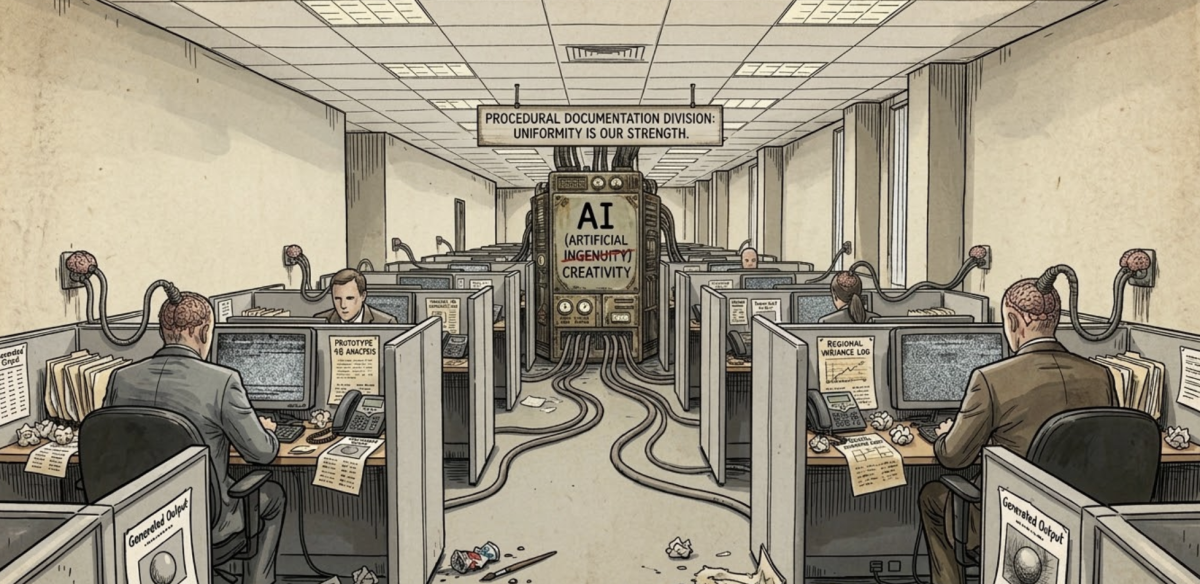
funny thing is, is the cover image not ai?? does this not contradict the whole point of the article?