




In my Christian Studies class, we recently had a debate about whether it’s okay to call someone’s opinion “wrong.”
Almost everyone argued that yes, some opinions are wrong. In fact, one person even changed sides halfway through the discussion. I was one of the only people who held my ground and said no. Here’s why:
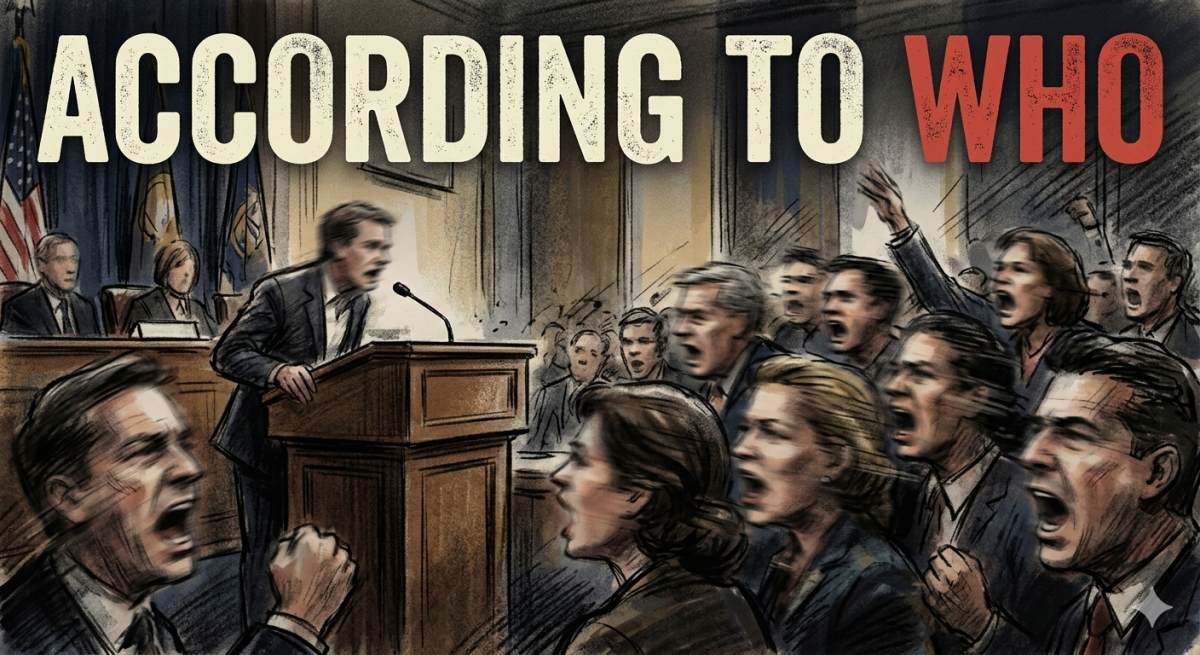
By definition, an opinion is a personal belief, view, or judgment. It isn’t a measurable fact. It isn’t a statistic. It isn’t something you can put under a microscope and test in a lab. So, when someone says an opinion is “wrong,” my question is simple: according to who?
In a school that views issues through a Christian lens, it makes sense that certain opinions will be disagreed with. Christianity, like any worldview, has its own beliefs about truth, morality, and right and wrong. But disagreement is not the same as incorrectness. Saying “I disagree with your opinion” is very different from saying “your opinion is wrong.” One expresses personal or theological conflict; the other claims objective authority.
Of course, facts that support an opinion can absolutely be wrong. If someone says, “I believe this because of X fact,” and that fact turns out to be false, then yes — the fact is wrong. But that doesn’t automatically make the opinion itself wrong. It may make it poorly supported. It may make it less convincing. But opinions are not math equations that become invalid once a number is off. They are personal perspectives.
Not all opinions even require research or evidence. Some are based on values, experiences, feelings, or interpretations. If someone says, “I think this is unfair,” or “I believe this is the right thing to do,” that belief is shaped by who they are. You can challenge it. You can question it. You can offer counterarguments. But labeling it as “wrong” assumes there is a universal judge of personal perspective.
And that brings me back to the central issue: who gets to decide?
In matters of fact, we can look to evidence. In matters of faith, Christians look to Scripture. But in matters of opinion, the line becomes less clear. Disagreement is healthy and debate is important. Changing your mind, as we saw in class is part of growth. But calling an opinion “wrong” risks shutting down discussion rather than encouraging it.
Maybe instead of asking whether opinions are right or wrong, we should ask whether they are thoughtful, kind, informed, or open to challenge. That shifts the focus from authority to understanding.
Because at the end of the day, when someone says your opinion is wrong, it’s worth asking:
According to who?



Mrs McEwan • Mar 12, 2026 at 3:16 pm
Very well written and thoughtful. Probably helpful to define the terms ‘fact’ and ‘opinion’ to gain clarity. Facts are objective truth claims; opinions are subjective beliefs.
Chocolate ice cream is better than strawberry is subjective.
5 + 4 = 10 is objective (but false)
Life exists on other planets is objective (but unknown)
Tom H • Mar 13, 2026 at 11:45 am
Yeah probably would be helpful but thank you for that definition! Thats exactly the difference that is vital. Something is in the works regarding this… keep your eyes peeled!
Peyton F • Mar 7, 2026 at 7:38 pm
and what if i said the earth was flat
Tom H • Mar 11, 2026 at 8:52 am
The earth being round is a scientifically proven fact, proven by the way ships disappear bottom-first over the horizon, and curved shadows cast on the moon during lunar eclipses. Some things are facts, however if your opinion is that its all a conspiracy, I can disagree whilst encouraging you to back it up with facts and evidence. If I deem it insufficent in comparison to my reasons otherwise, then I can politely and thoughtfully disagree. The existence of groups like the Flat Earth Society is actually a good example of what I mean: I can disagree with them strongly, even call their facts wrong, while still recognizing that their conclusion is their interpretation of the world.
Tom H • Mar 11, 2026 at 8:58 am
The existence of the society proves that people will hold and defend beliefs regardless of evidence which is exactly why I think persuasion works better than declaring someone wrong
Peyton F • Mar 11, 2026 at 9:42 am
Just because their conclusion is their interpretation of the world does not remove the fact that they ARE wrong, which is what your saying cannot happen, your saying opinions can’t be wrong which they very much can
Well you were not saying that persuasion is better than calling an opinion wrong, because I agree on that matter, you were saying that no opinion is wrong, which I don’t agree with
Tom H • Mar 12, 2026 at 9:09 am
I think you may have missed the point of the article. According to who? Are you the supreme moral judge of our universe? Is it a higher God? Is it someone/something else? Its a challenge to the idea that opinions can be wrong as there is an obvious question as to who gets to decide. It appears that you are making an assumption (one which is very common) that there is objective morality. All I’m doing with this article is simply challenging that way of thinking. This kind of conversation is exactly the kind that needs to be had and I commend your thought process.
Peyton • Mar 14, 2026 at 12:27 pm
Well according to the fact that its not all a conspiracy. Maybe there is objective morality. if 99.99% of the human population agrees that murder is wrong, then perhaps that opinion is correct, and the belief of otherwise is wrong. I think you might have liked the elective philosophy course, things like this were well discussed.