




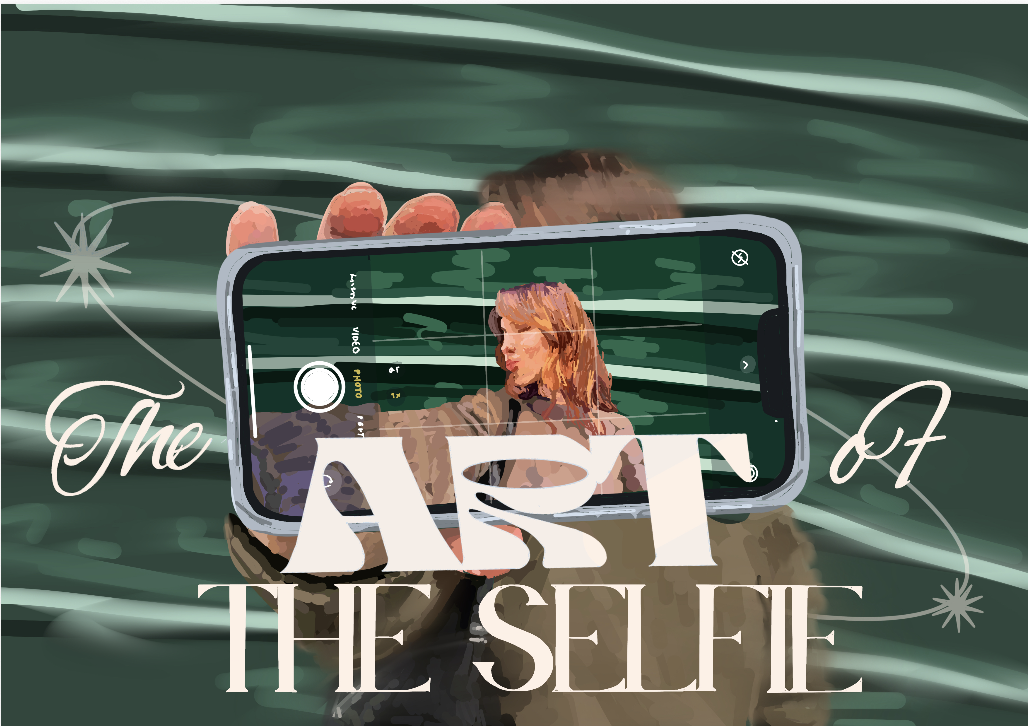
Do you have a favourite selfie? I do. Mine isn’t particularly special. It costs a radiant glow of my face my hair half frizzed half brushed out and right beside me is my best friend joining her head right next to mine. Every time I view that photo, I remember exactly how that day had felt… loud unpredictable and unfiltered. It is at this point where I wonder are selfies taken to see ourselves clearly or to show the world and our Instagram followers who we are?
The word ‘selfie’ was officially recognised by the Oxford dictionary in August 2013, which really says a lot about how this idea quickly embedded itself into our daily lives. What began as a simple experiment of the iPhone has now developed into a worldwide language. On platforms such as Instagram or TikTok, a selfie isn’t just a photo, it’s a performance, a brand an identity, or even a marketing strategy. We don’t just post our face we curate it. Every expression, the slightest curve of a mouth, every slight mark is carefully considered, adjusted and presented to the world as if it were a finished masterpiece.
In this sense, selfies often feel like mirrors, serving as a reflection of how we see ourselves, or perhaps how we WANT to see ourselves. There’s a certain control in choosing the ‘perfect ‘angle, the filter, the caption. You are stuck in the cycle of asking what stays in an what gets cropped out. A bad skin day? Delete. Awkward smile? Retake. Uneven skin tone? Filter. The mirror of the selfie is forgiving, adjustable and flattering. It allows young people especially, to experiment their identities in ways that were considered to be unimaginable years ago. We have the ability to try on thousands of filters, such as bigger eyes, smoother skin, fuller lips, lighter freckles or even a completely different aesthetic altogether. You begin to craft different versions of yourself, testing to see which version of you attracts likes, comments, views… validation.
But here’s the thing. Mirrors can distort.
When every image is filtered, edited and measured by followers’ engagement, the reflection starts to blur. Studies have often linked heavy social media usage to an increase in body dissatisfaction, particularly among female teenagers. Scrolling through endless images of seemingly flawless faces, it’s easy to forget that most of them have been carefully and intricately constructed. Slowly, the selfie becomes less about expression an more about comparison. Instead of asking ourselves, “Do I like this photo?”, we ask, “Will they?”. Yet, reducing selfies to vanity seems unfair. And this is where the idea of a selfie being a window comes in.
Selfies can be windows into an experience. Think about the hundreds of travel photos, graduation photos, your children’s first steps, the last picture with a family member before they passed. A selfie taken during these moments isn’t just about what we see in the frame, but rather, the story behind it. Even a selfie on a family dinner night, or after finishing a long study session can help preserve the tiny moments that would otherwise fade. The seemingly ordinary selfies, curled up with a book by the fireplace, can become time capsules, windows into our mood, our personality, and our daily lives. These moments are intimate. Not only do they showcase how we look, but how we feel, what we value and how we choose to experience the world. In this perspective selfies allow us to preserve ourselves in ways that no mirror can. A mirror only showcases the surface, but a selfie, when utilised as a window, can capture what it feels like to be in the moment. For some people, especially young girls and women, selfies can be empowering. Posting your natural hair, your cultural dress and even your scars quietly resist the narrow beauty standards. A window can show who you really are.
So, are selfies a window or a mirror? I don’t think they’re only one. They shift depending on our intentions. My favourite selfie doesn’t showcase perfection. It showcases memory, connection, a window into a younger version of myself capturing these intimate moments that I would hold onto for the rest of my life. It feels like staring less into a mirror and more like opening a window.
Perhaps the real question isn’t what selfies are, but rather, how we use them. Are we seeking approval or capturing an experience? Like most things, selfies are crafted by hands holding the phone. Maybe that’s the most contemporary truth of all… In a world where we are constantly seen, the selfie rarely gives us a chance to decide HOW.