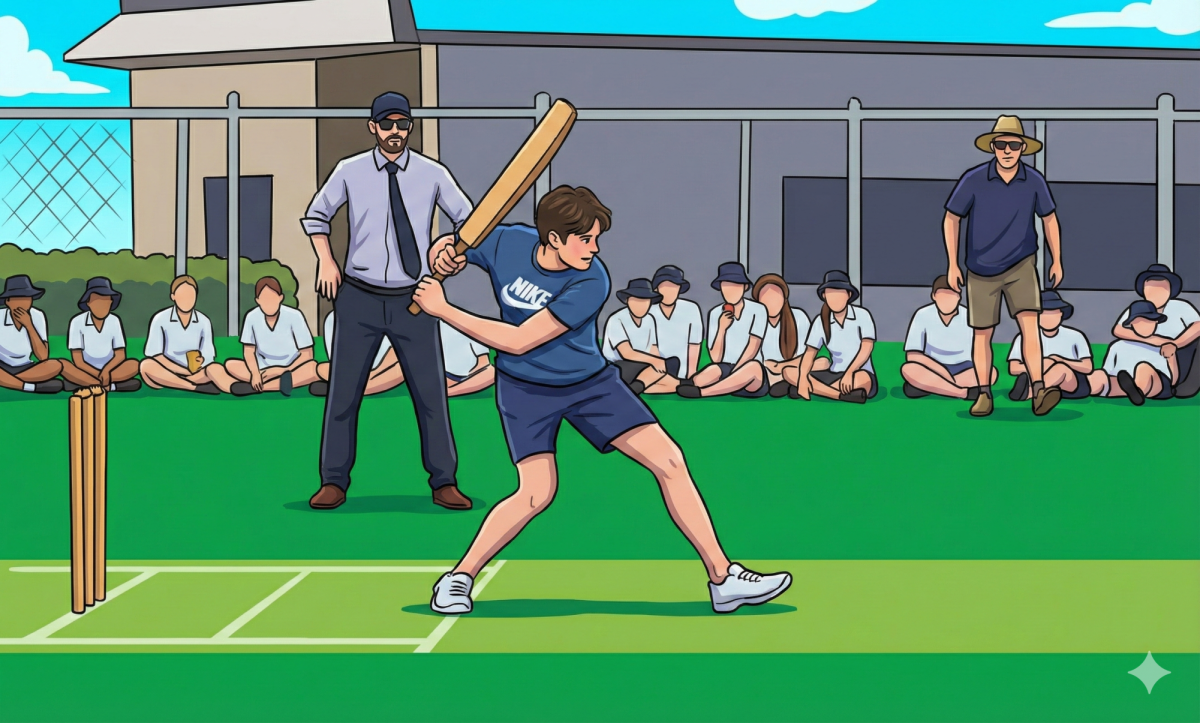




William Clarke College is a school to over 1900 students and 260 staff and with the campus being approximately 23.6 acres in size the area per person sits at a comfortable 44.6m2 per person. But what happens if all of these 2160 people want to move from one place to another, say, to get to assembly? This here is the cause for all this congestion within campus. The struggle to move to your next class after recess or lunch at the same time as everyone else in the college is bound to cause disruption.
Over the course of 2 weeks, I documented my passage through the college in hopes to collect data on the traffic. However, due to my poor timing this experiment took place during camp week and HSC meaning there was significantly less traffic, and the sport centre (the biggest victim of traffic) had no commuters. I do however give a very strong thank you to those who sent me their traffic data, encouraging me to continue on from that last article.
So, due to the discrepancy in my data I have no choice but to comment on observation without the numbers to back me up. Despite the lack of credibility this may cause, I ensure you that my observations will reflect the truth of the matter and not something to be ignored.
Starting with the largest cause for traffic once every fortnight, the journey to the sports centre for assembly can often cause delays up to 5 minutes. This because, as stated before, it consists of a great number of commuters taking a narrow path to cross the road. If you start this journey from the Branwhite or Amphitheatre it gets even worse as you have to cross the entire campus before reaching the traffic jam. It’s plain to see that the very root cause of this event are the two pathways one must take to get to the sports centre, you could either go from the oval and exit out gate 12 or exit gate 10 and walk along the bus bay. Both of these paths have a width of approximately 2 meters heavily restricting the flow of traffic. What makes this even worse is when these paths then merge at the pedestrian crossing which while it is much wider, it combines commuters from path 1 and 2 and also passage through this crossing can also be halted when a car wishes to use it as well which temporarily cuts off the flow of traffic. The amount of time it takes for the people in the college to make their way to the sports centre will always delay the start of assembly and force it to eat into the time given for recess. If the executives at the college wish to make the most out of the 25 minutes for assembly, allowing students to quicker get to their seats should be discussed and the issue at hand to be resolved.
This area doesn’t only impact assemblies either, as the sports centre is also where Interhouse takes place. When Friday lunch ends and everyone begins to make their way to class, the same situation occurs with the assemblies. Only this time you have students going from the sports centre as well as some students going to the sports centre for class. As someone who has class in that area after lunch on Friday, it is very difficult to ‘swim against the current’. I can also imagine this to be the cause for several latencies to class, the excuse of “I was at Interhouse” is a sad reality for both students and teachers that this event should cause attendance problems.
Other current traffic issues include: the mass exodus from the Branwhite at the end of the day, passage through the construction zone, and getting to the library. These issues are either inevitable or only impact a relatively small fraction of the college, but they still deserve some attention. Leaving the Branwhite at the end of the day, in my opinion, isn’t so bad as the door and path is wide enough to support the numerous students. The concern instead lies when someone tries to enter the Branwhite at this time, trying your best to squeeze through the current it’s easy to find yourself shuffling against the wall. While this is certainly annoying, it doesn’t have a large enough impact on the greater college to require a solution and if you find yourself in this situation it may just be easier to take the entrance to the bottom floor. Moving on to the traffic caused by the current construction of the Bryson building, the limited, and tight passages have effectively created a divide in the college campus. Despite the major inconveniences it causes, I am in full understanding that this congestion is inevitable due to the nature of construction particularly as it takes place in the centre of campus. I certainly am one of many who can’t wait for the building to be complete to remove this border and looking to the future I predict that the Bryson building once finished won’t add to the traffic seeing as it’s in the centre of campus and should have many exit points. Now the least impactful but most annoying congestion, entering the college library. I say it’s the least impactful as the issue only troubles the select students who use the library during lunch times. See, the library has 2 passages to it door, both being a flight of stairs. If you take the stairs next to the oval, you have to pass the bags that people leave on the stairs and shuffle past anyone using the stairs as a place to sit. Once you’re at the top of the stairs you pass through a narrow hallway inhabited by the primary students, once you make your way through you then have a clear path to the entrance of the library. If you don’t want to go that way, you can go up the stairs near the Cola. These stairs are more out-of-the-way so don’t get as much traffic; the top of these stairs take you right to the library entrance giving you significantly less trouble than the other route. These stairs mainly falter due to them being more difficult to get to than the other.
Being in my last year at William Clarke, I’ve picked up some simple strategies to bypass the majority of traffic. Very simply planning your route can help a lot, sometimes it’s easier to take a different route than the direct one. Timing is also an important factor, leaving early to dodge the traffic at the expense of a slightly shorter break time, this strategy does however backfire when going to the sports centre after Friday lunches.
There are also some habits that if the majority of the college implement, theoretically the problem of traffic will be much diminished. These habits start with a simple rule of sticking to the left, just like driving this should create 2 lanes going either way and also follows Australian road laws of driving on the left. Another action you can take to be considerate to your peers, when walking in a group it is much more efficient to walk in a line along the path rather than across the path which allows people to pass by instead of either being stuck behind others or having to excuse themselves to overtake. While this does make it harder to talk with your friends while you’re walking it is arguably many times more efficient especially on the narrow paths.
To close, William Clarke has many problems caused by traffic and congestion, but I believe that if we as a college are more aware of our traffic and what causes it, we can then take action to minimise time loss and congestion. Being considerate of others on the path and planning accordingly your route and timings. Also, by bringing this to light I hope that measures will take place to widen the access to the sports centre, this would be of great benefit to the college.
TL; DR
William Clarke’s traffic is caused by narrow paths being used by a large number of travellers, which while out of our control we can help to minimise congestion.